Parsimony Cloud ERP
Managed ERPNext, built by operators.
Parsimony hosts ERPNext on Frappe Cloud, implements it, migrates your data, trains your team, and supports it afterwards. The people who configure your system have run warehouses, marketplaces, and month-end closes themselves.
The call is 15 minutes: current stack, data volume, modules. The quote follows in writing.
- ERPNext · Frappe Cloud · US / EU / APAC
- 99.95% uptime target
- Quoted to the job
01 — Operator note
ERP from operators, not a demo team.
Most ERP vendors are software companies that have read about business. Parsimony is operators who build software.
We ran the businesses first: multichannel ecommerce, distribution, and the sourcing and quality work behind them. We know which spreadsheet breaks first, which report the owner reads on Monday, and which approval chain quietly stops working when the team doubles.
That experience is the foundation of every module, dashboard, and workflow we build. Your ERP is not just configured; it is informed by the same problems we solved for ourselves.
The rest of this page is what an engagement contains: the modules, the go-live plan day by day, what is included, and one customer's numbers. Read it the way you would read a spec.
This is the whole argument for an ERP in one figure. A sales order, the delivery against it, the invoice for it, the ledger entry it posts, and the payment that closes it are one chain, on one item master, in one database. When those live in four tools, month end is a reconciliation project. When they live in ERPNext, month end is a report.
02 — Parts list
Standard ERPNext, plus the modules we built for ourselves.
ERPNext is the foundation. What Parsimony adds on top are the modules that solve the problems an operator meets as the business grows, built on standard DocTypes with custom fields, workflows, and reports.
- 01
Supply chain tracking
Purchase orders, supplier lead times, inbound shipments, and landed cost from raw material to finished good across suppliers, warehouses, and countries. Alerts on lead-time slips and stockout risk.
Built on: Purchase Order · Supplier · Landed Cost Voucher · custom Shipment tracker
- 02
Quality control and compliance
Inspection checklists per product category, inspector reports filed on site, defect and non-conformance tracking, and supplier scorecards that read from the inspections. Figure 3 shows the schema.
Built on: Quality Inspection · Quality Inspection Template · Non Conformance · Supplier Scorecard
- 03
Manufacturing and production
Bills of materials, work orders, job cards, capacity planning, and shop-floor status for manufacturers who need to see every run while it is running.
Built on: BOM · Work Order · Job Card · Workstation
- 04
Product development lifecycle
Specs, revisions, approvals, and sample rounds in one record that hands off to purchasing and manufacturing when the product is signed off.
Built on: Item · Item Variant · custom Product Spec and Sample Round
- 05
Multi-entity reporting
Departmental P&Ls, consolidated statements across companies and currencies, and the handful of KPIs an owner reads every Monday.
Built on: Company · Cost Center · Consolidated Financial Statement · Dashboard
- 06
Operator alerts
Notifications and scheduled reports written from running businesses: a late supplier, a margin below floor, a customer past terms. The system says what to do next, not only what happened.
Built on: Notification · Auto Email Report · Server Script
A purchase receipt cannot post without an inspection. The inspection reads its checklist from a template per item group, so an inspector on site sees the right questions for that product. Rejected stock goes to its own warehouse and opens a non-conformance; the supplier scorecard reads from both. The module's own page is at /quality-control.
Standard ERPNext modules
| Module | What it covers |
|---|---|
| Accounting | Chart of accounts, AR/AP, bank reconciliation, financial statements, multi-currency |
| Stock | Items, warehouses, batches and serials, valuation, stock reconciliation |
| Selling and CRM | Leads, opportunities, quotations, sales orders, pricing rules |
| Buying | Suppliers, RFQs, purchase orders, receipts, supplier scorecards |
| Manufacturing | BOMs, work orders, job cards, capacity and material planning |
| HR and payroll | Employees, leave, attendance, expense claims, salary structures |
| Projects | Projects, tasks, timesheets, billing against tasks |
| Assets | Fixed assets, depreciation schedules, maintenance |
| Quality | Inspection templates, inspections, goals, non-conformance |
| Support | Issues, service level agreements, maintenance visits |
| Website and ecommerce | Item catalog, web forms, connectors for Shopify and Amazon |
| Reports and dashboards | Report builder, query and script reports, dashboards, print formats |
Built for the next stage
The system that works at one warehouse breaks at three.
We design for the complexity you will have in three years, not the complexity you have today. Stages are counted in entities, sites, and suppliers, because that is what the software has to carry.
| Stage | What breaks | What we add |
|---|---|---|
| One entity, one warehouse | Spreadsheets hold inventory; QuickBooks holds the ledger; nobody trusts either at month end. | Accounting, stock, selling, and buying on one item master. Replace the spreadsheets. |
| Several locations, several suppliers | Stock counts drift between sites; supplier lead times live in someone's inbox; quality problems surface at the customer. | Supply chain tracking, quality control, multi-warehouse transfers, and reports the team actually opens. |
| Several companies, several currencies | Consolidation is a quarterly project; intercompany balances never tie; the product team works outside the system. | Multi-company consolidation, manufacturing, product development lifecycle, and the operator alerts. |
03 — The plan
The go-live plan, day by day.
Typically weeks, not quarters. This is the two-week plan we run for one entity with clean masters; HumanityNow went live in about two weeks on it. Multi-company cutovers and EDI add weeks, and the written scope says how many.
| Day | Work | What happens | Output |
|---|---|---|---|
| 1–2 | Discovery | Walk the current stack, count entities, users, SKUs, and open transactions. Agree the cutover date. | Written scope and data inventory |
| 3–5 | Chart of accounts and masters | Map the chart of accounts. Import customers, suppliers, items, warehouses, and price lists. | Configured company with clean masters |
| 6–8 | Open transactions | Load open AR and AP, opening stock by warehouse, and opening balances. Reconcile every total to the source system. | Trial balance that ties to the old books |
| 9–11 | Workflows and acceptance | Configure roles, approvals, print formats, and the custom modules in scope. The team runs a week of real orders in the test site. | Signed-off test cycle |
| 12–13 | Training | Live sessions per module, recorded walkthroughs, and written SOPs. Each role practices its own day. | SOPs and recordings in the customer's hands |
| 14 | Cutover | Final delta load over a weekend, validated against the old system, then the old system goes read-only. | Live site, old system frozen |
Reconciled, not rushed
Every opening balance ties to the old system before the cutover weekend. The old books go read-only, they are not deleted.
Your data, your call
You decide how much history comes across. Open transactions always; closed years as summaries or in full.
Training before go-live
Each role runs its own day in the test site before the switch. Nobody learns the system on a live order.
04 — Spec plate
Open source. Managed. Yours.
01 — No black boxes, no per-user license
Open source.
ERPNext is open source, built on the Frappe framework. You can read every line, change any module, field, or workflow, and move your installation anywhere.
- Full access to the source code, always
- Customize any module, field, or workflow
- An active global developer community
- No per-user licensing fees
02 — We run the infrastructure
Managed on Frappe Cloud.
We host, patch, back up, and monitor your ERPNext site on Frappe Cloud, in the region you choose. You run the business; we run the servers. The uptime target is 99.95%. A contracted SLA exists only in a signed customer agreement.
- 99.95% uptime target
- Daily encrypted backups, point-in-time restore
- Managed updates, patches, and performance tuning
- US, EU, and APAC regional deployments
03 — Always, no exceptions
You own your data.
Your data belongs to you, not to us and not to a vendor. Export everything at any time in standard formats. If you ever want to move, we help you migrate out. No hostage situations, no fee to read your own records.
- Full data export at any time, in standard formats
- Your data is never used for training or analytics
- Bring your own cloud if you prefer
- Custom code is yours, in your repository
Hosting options, including self-host, are compared on /erpnext-hosting. ERPNext vs Odoo, with ERP Research's figures, is on /vs-odoo.
05 — The system
What the screens look like.
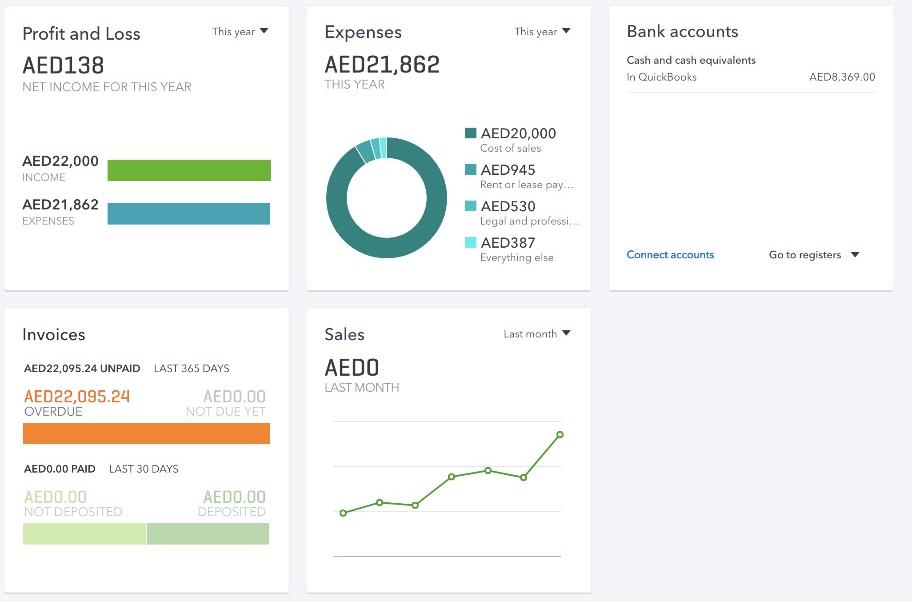
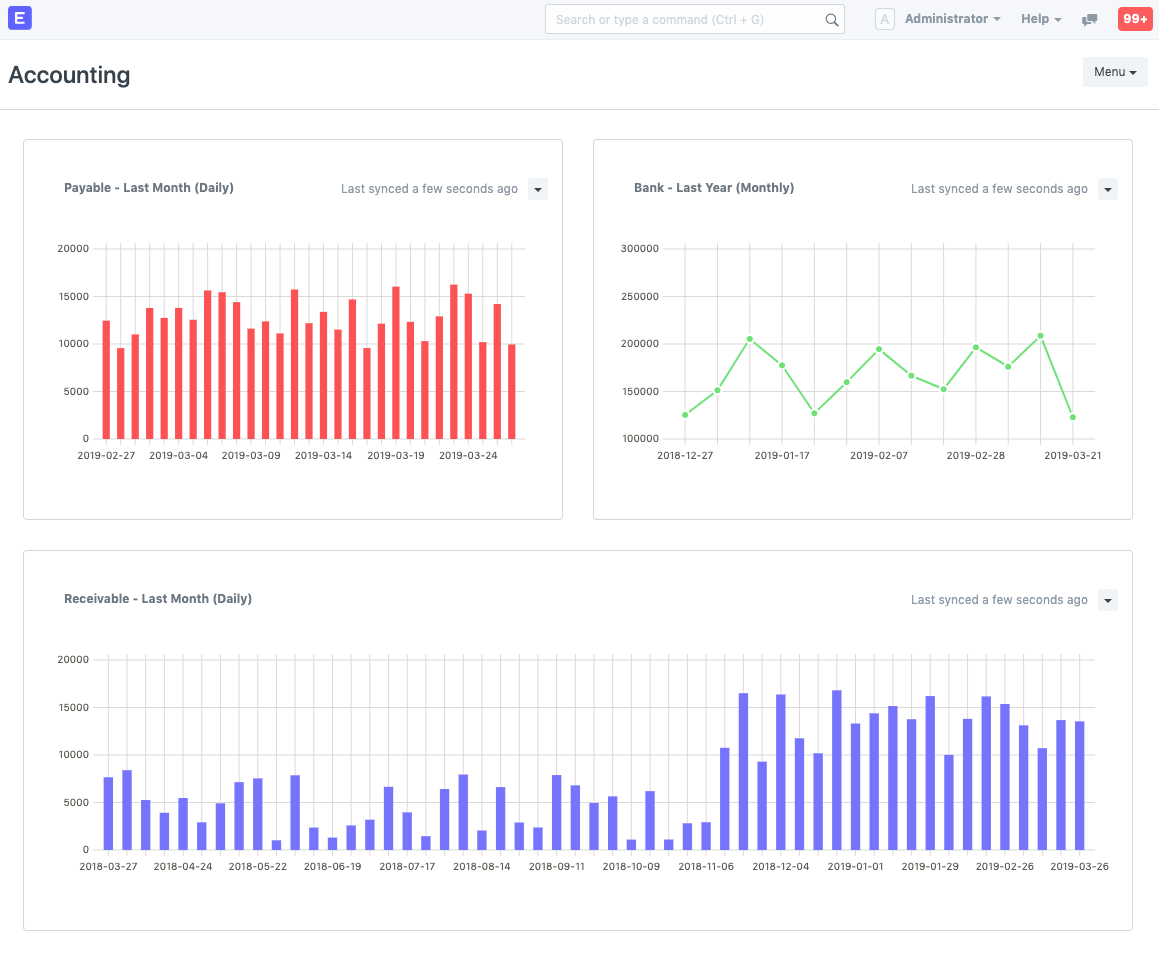
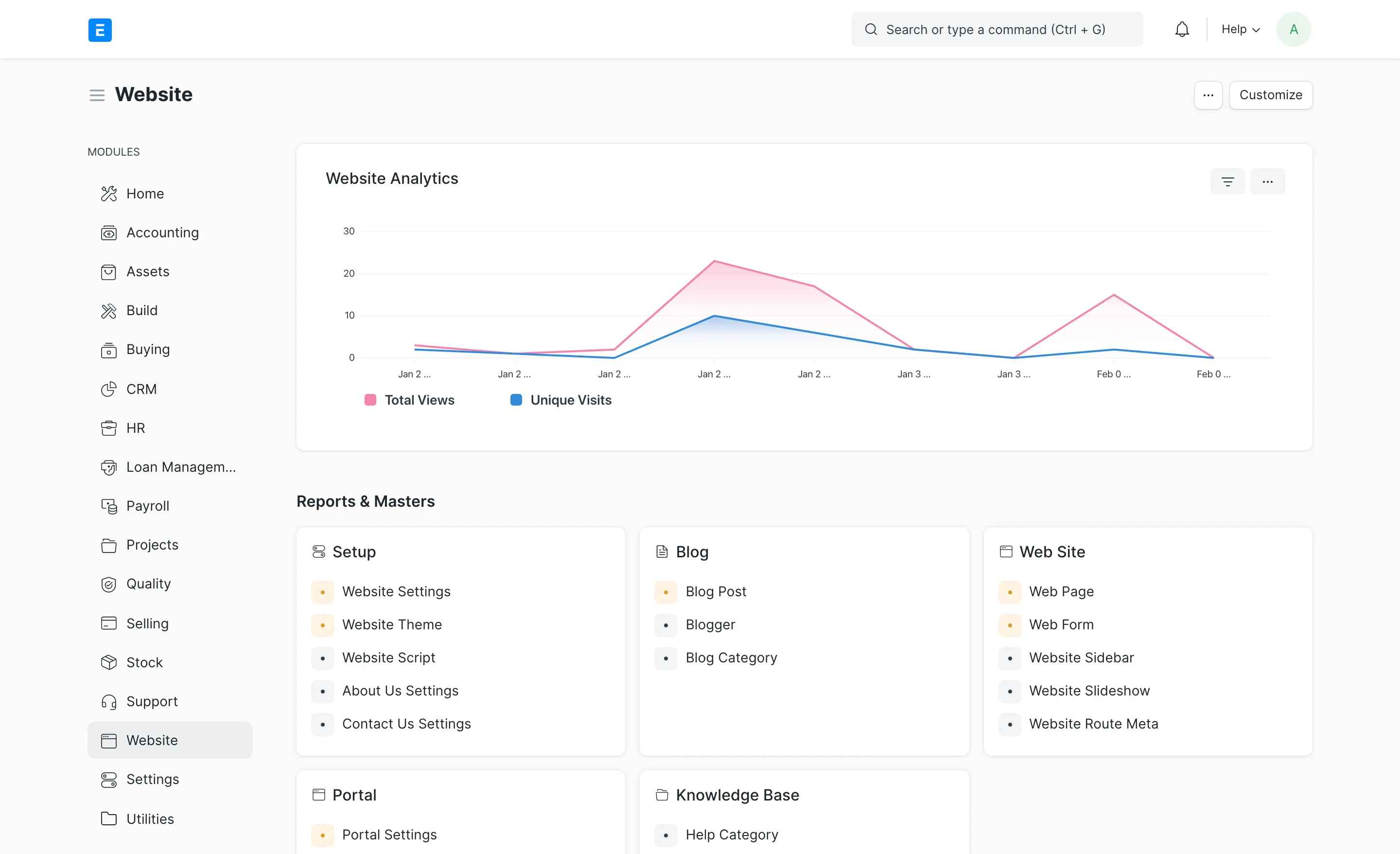
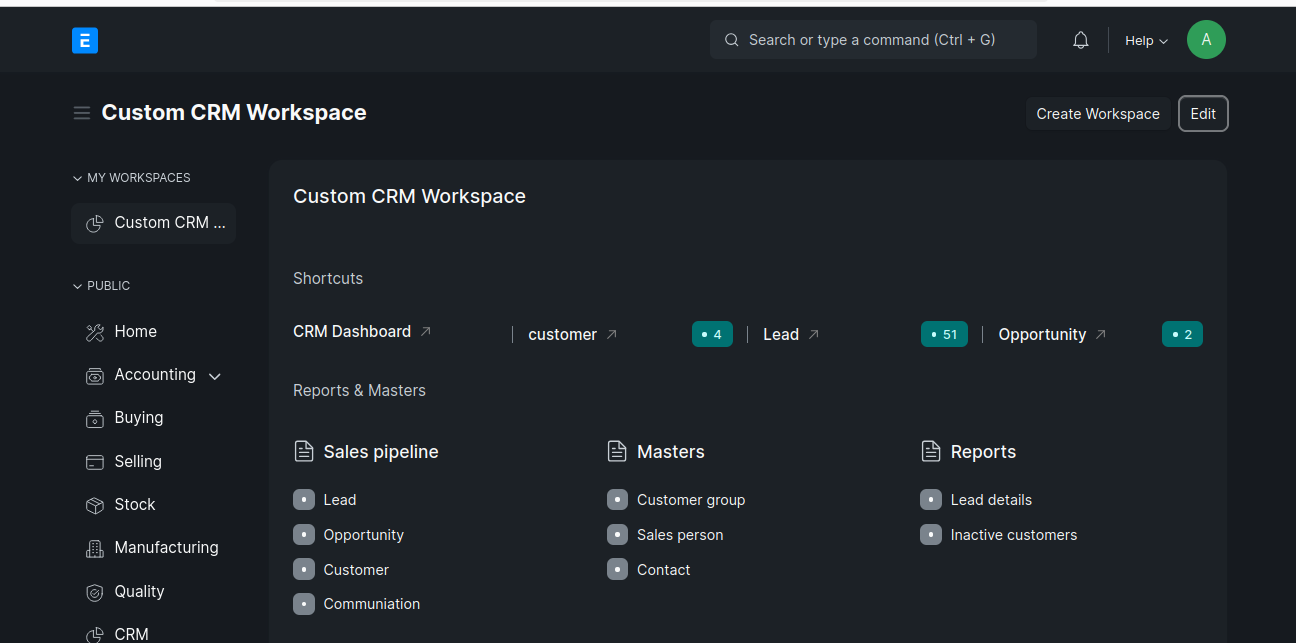
Four screens from a live ERPNext site. The full walk-through is a call, not a video.
06 — Services
We do not hand you software and leave.
Six things every engagement can include. Implementation and Frappe development in more depth are on the services page.
- 01
ERPNext implementation
We configure and deploy ERPNext for your business: chart of accounts, item master, roles, approvals, print formats, and the custom DocTypes and workflows that match how the business actually runs.
- 02
Data migration
From QuickBooks, NetSuite, Odoo, Sage, or spreadsheets. We extract, clean, and import the history, then reconcile every opening balance to the source before the cutover weekend.
- 03
Team training
Live sessions, recorded walkthroughs, and written SOPs for every module your team uses. We do not go live until each role has run its own day in the test site.
- 04
Custom Frappe development
A DocType that does not exist yet, a third-party integration, a report nobody has written. Our Frappe developers build it and the code lives in your repository.
- 05
Ongoing support
A support team that knows your setup, not a generic queue. Phone and email, with the same people who did the implementation.
- 06
Go-live, weeks not quarters
The day-by-day plan above is what we run when the data is clean and the scope is one entity. Multi-company cutovers with EDI or custom modules take longer, and the written scope says how long before you sign.
Moving to V16?
Free narrated lessons for every role.
Short video lessons walk through the new Parsimony ERP V16 interface for sales, buying, inventory, accounting and administration. No account needed.
07 — Start with the analysis
$999, pay at Stripe, as of Oct 2026The written blueprint, for one price.
Before anything is quoted, our systems architects map how the business runs today — how a lead becomes a customer, how an order is fulfilled, where data is typed in by hand, where the silos are — and deliver a written, tailored blueprint: which ERPNext modules to use, which integrations to build, and the order to do it in. $999, as of Oct 2026, fixed, paid once at Stripe, no hourly surprises; the engagement below is quoted separately, from that blueprint.
Read about the $999 operations analysis, as of Oct 202608 — Bill of materials
What is in a managed ERPNext engagement.
No scorecard against other vendors here; those need someone else's numbers, and they live on the hosting and Odoo pages. This is what Parsimony includes and what is quoted.
| Item | Status | Notes |
|---|---|---|
| Operations analysis | $999, pay at Stripe, as of Oct 2026 | The written blueprint — workflows, modules, integrations, order — before anything is quoted. Stands on its own. |
| ERPNext license | Included | Open source. No per-user fee. |
| Frappe Cloud hosting and region choice | Included | US, EU, or APAC. |
| Backups, patches, monitoring | Included | Daily backups, managed updates, 99.95% uptime target. |
| Implementation and data migration | Quoted | Scoped in writing after the assessment call. |
| Custom modules and Frappe development | Quoted | Code delivered to your repository. |
| Training and SOPs | Included in implementation | Live sessions, recordings, written SOPs. |
| Ongoing support | Quoted | Monthly, sized to users and modules. |
| Data export and exit | Included | Standard formats, any time, with migration help if you leave. |
Ecommerce and marketplaces
Parsimony's roots are multichannel ecommerce and distribution. ERPNext carries the item catalog, batch and serial tracking, landed cost, and multi-warehouse stock those businesses need. Frappe publishes open-source connectors for Shopify and Amazon; Parsimony's ShipStation integration for ERPNext is open source on GitHub; other channels connect through the REST API. Multi-company, EDI, and legacy cutovers are on /enterprise-erp.
Not in the box
We do not publish a monthly ERP list price, we do not claim a partner certification we do not hold, and we do not promise a go-live date before the data inventory. The written scope from the assessment call is where the numbers and the date live.
09 — Customer record
One nonprofit, six countries, one ledger.
- Before
- HumanityNow was running operations across 6 countries using a patchwork of QuickBooks, spreadsheets, and manual reporting. Monthly financial close took 3 weeks and the team had no real-time visibility into budgets.
- Work
- Parsimony migrated HumanityNow to Frappe Cloud ERP — a fully managed ERPNext deployment with custom modules for multi-currency accounting, grant tracking, and procurement across 6 country entities.
- After
- Monthly financial close dropped from 3 weeks to 4 days. The operations team gained real-time visibility into 6 country budgets from a single dashboard. HR, payroll, and procurement are now unified, saving 40+ hours of manual work per month.
Published metrics
- 01
4 days
Monthly close (was 3 weeks)
- 02
6
Country budgets in one dashboard
- 03
40h
Manual work eliminated per month
Go-live: about two weeks. Figures as published on the customer record.
10 — Questions
What buyers ask before the call.
- 01
What does “managed ERPNext” mean?
ERPNext is the open-source ERP from Frappe. Managed means Parsimony hosts it on Frappe Cloud, keeps it patched and backed up, implements it for your business, migrates the data, trains the team, and supports it afterwards. You get one partner for the software and the operations of the software.
- 02
What does Cloud ERP cost?
It is quoted to the job. Hosting is sized to users, storage, and region; implementation is sized to entities, modules, and the state of the data. There is no public list price because two businesses with the same headcount can need very different work. The assessment call produces a written scope with numbers in it. If you want the map before the quote, the operations analysis is $999, as of Oct 2026, fixed, paid at Stripe, and delivered in writing.
- 03
How long does an implementation take?
Typically weeks, not quarters. HumanityNow went live in about two weeks on the plan above. A single entity with clean masters follows that plan; several companies, EDI, or a custom manufacturing flow add weeks, and the scope says how many.
- 04
Can we migrate from QuickBooks?
Yes, and it is the most common starting point. We map the chart of accounts, import customers, suppliers, and items, load open AR and AP and opening stock, and reconcile the trial balance to QuickBooks before cutover. NetSuite, Odoo, Sage, and spreadsheet migrations follow the same steps.
- 05
Does it work for ecommerce and marketplace sellers?
That is where Parsimony started. ERPNext carries an item catalog, batch and serial tracking, landed cost, and multi-warehouse stock. Frappe publishes open-source connectors for Shopify and Amazon; Parsimony's ShipStation integration for ERPNext is open source on GitHub; other channels connect through the REST API. Settlement reconciliation and SKU-level margin are built as reports in your site.
- 06
Who owns the data and the custom code?
You do. Data exports in standard formats at any time; custom apps live in your repository. If you leave, we help you move to another host or to your own servers.
- 07
Where is it hosted and what is the uptime target?
On Frappe Cloud, in the US, EU, or APAC region you choose. The uptime target is 99.95%. A contracted SLA exists only in a signed customer agreement. Hosting alternatives, including self-hosting, are compared on the ERPNext hosting page.
- 08
Is there training for our team?
Live sessions and recorded walkthroughs are part of every implementation, with written SOPs per role. Parsimony also runs a free online training catalog for ERPNext modules; see the training page.
Pricing
Parsimony Chat and Automate are self-serve.
Cloud ERP is quoted.
Parsimony Chat, the AI chat and voice agents, is $97 / $197 / $497 a month, as of Oct 2026, with a 15-day free trial — see the Chat packages. Parsimony Automate is $57 / $199 / $497 a month, as of Oct 2026, with a free trial on every plan (30 days on Startup, 7 on Professional and Premium) — see the Automate plans. Cloud ERP is quoted to the job: call or send the form and we put a package together.
- 01$97 / $197 / $497 a month, as of Oct 2026 · self-serve
Parsimony Chat
AI chat and voice agents: chat on your site, voice on your phone line, trained on what you upload. 15-day free trial. No credit card required.
- 02$57 / $199 / $497 a month, as of Oct 2026 · self-serve
Parsimony Automate
CRM, funnels, two-way text, workflows, and websites, billed at Stripe.
- 03Quoted
Parsimony Cloud ERP
Managed ERPNext on Frappe Cloud. Quoted to the job; the operations analysis is $999, as of Oct 2026, the fixed-price first step.